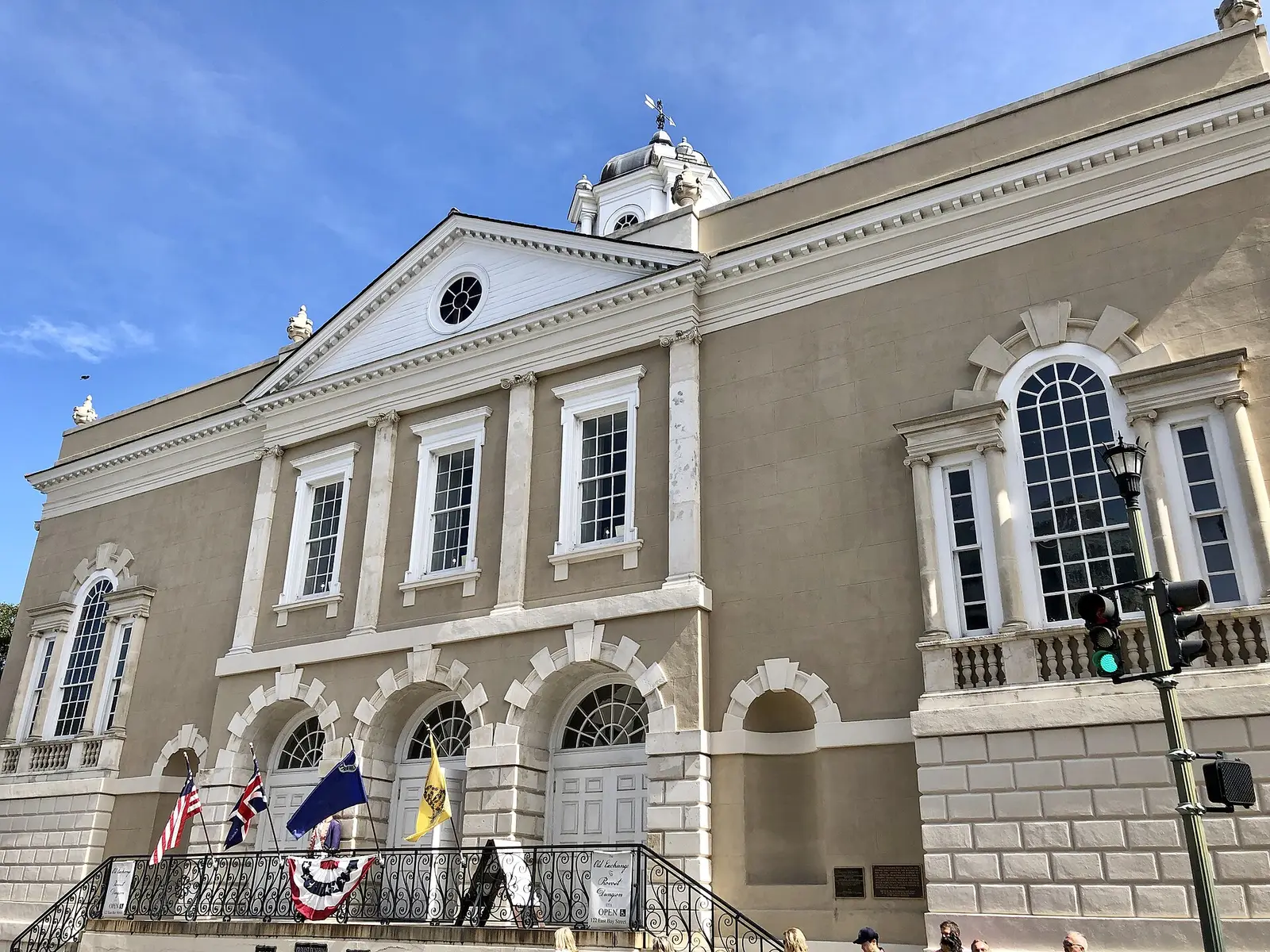
Charleston was founded in 1670, moved to Oyster Point in 1680 and incorporated in 1783. Every National Register listing in the city, with its year.
Last checked Oct. 12, 2026. Founding and incorporation facts come from the City of Charleston’s city history page, its seal history and its list of intendants and mayors. National Register listings come from the National Park Service’s National Register location data. Hours are as each museum publishes them.
Charleston calls itself the oldest and largest city in South Carolina and the seat of Charleston County. Its seal still carries the dates that matter: Carolopolis Condita A.D. 1670, founded in 1670, and Civitatis Regimine Donata A.D. 1783, incorporated in 1783.
Who to call
- City records and history: Clerk of Council and Records Management, 843-724-3727, 80 Broad St.
- Historic preservation and the Board of Architectural Review: Planning and Preservation, 843-724-3765
- Old Exchange and Provost Dungeon: 843-727-2165, 122 E. Bay St.
How the city began
- 1670. Charles Town, named for King Charles II of England, was established on the west bank of the Ashley River at Albemarle Point. The National Park Service lists the Site of Old Charles Towne on the National Register (1969).
- 1680. The settlement moved across the river to its present site on Oyster Point.
- 1783. Charles Town was incorporated as a city and adopted the name Charleston. The city was governed by intendants from 1783 to 1836, the first being Richard Hutson in 1783, and by mayors since.
The seal adopted in 1783 shows a seated woman, a ship under sail and the city’s steeples, with the motto Aedes mores juraque curat: she guards her buildings, customs and laws. The seal on top of City Hall dates from about 1818-1820, the city says.
The historic district
The Charleston Historic District, first drawn roughly between Broad, East Bay, South Battery and Ashley, plus Church Street between Cumberland and Chalmers, was listed on the National Register in 1966 and is a National Historic Landmark. It has been enlarged repeatedly: in 1970, to an area bounded roughly by Calhoun, Archdale, Cumberland, East Battery, Broad and Gadsden; in 1978, to take in most of the peninsula south of Bee, Morris and Mary streets; and with smaller increases in 1984, 1985 and 1986. The French Quarter District was listed separately in 1973. Exterior changes inside the city’s historic districts go through the Board of Architectural Review; see our permits guide.
Museums and sites open to visitors
| Place | Address | Hours as published |
|---|---|---|
| Old Exchange and Provost Dungeon | 122 E. Bay St. | 9 a.m. to 5 p.m. Monday to Saturday; 11 a.m. to 5 p.m. Sunday |
| Old Slave Mart Museum | 6 Chalmers St. | 9 a.m. to 5 p.m. Monday to Saturday; closed Sunday |
| Nathaniel Russell House | 51 Meeting St. | 1 to 4 p.m. Monday; 10 a.m. to 4 p.m. Tuesday to Sunday (last tour 4 p.m.) |
| Aiken-Rhett House | 48 Elizabeth St. | 1 to 4 p.m. Monday; 10 a.m. to 4 p.m. Tuesday to Sunday (last tour 4 p.m.) |
| Fort Sumter Visitor Center at Liberty Square | 340 Concord St. | 9 a.m. to 4:30 p.m. daily; free |
The Old Slave Mart, built in 1859, is considered the last surviving slave auction gallery in the state, its museum says. The Nathaniel Russell and Aiken-Rhett houses are run by Historic Charleston Foundation. Fort Sumter itself is reached only by the National Park Service’s authorized boat, Fort Sumter Tours; all park sites close on New Year’s Day, Thanksgiving and Christmas, the park says. Old Exchange details are on oldexchange.org, and the Old Slave Mart’s on oldslavemartmuseum.com.
Cemeteries. The Coming Street Cemetery, 189 Coming St. (listed 1996), and the Charleston Cemeteries Historic District on Huguenin Avenue off Meeting Street (2017) are on the National Register. Ask each cemetery about visiting hours before you go.
Every National Register listing in the city
The National Park Service lists the following places with a Charleston address and not marked “vicinity,” with the year each was listed. (NHL) marks a National Historic Landmark. The historic district and its boundary increases are described above.
| Listing | Address | Listed |
|---|---|---|
| William Aiken House and Associated Railroad Structures (NHL) | 456 King St. | 1966 |
| Miles Brewton House (NHL) | 27 King St. | 1966 |
| Robert Brewton House (NHL) | 71 Church St. | 1966 |
| Fort Sumter National Monument | Charleston Harbor | 1966 |
| Clark Mills Studio (NHL) | 51 Broad St. | 1966 |
| St. Michael’s Episcopal Church (NHL) | 80 Meeting St. | 1966 |
| Exchange and Provost (NHL) | East Bay and Broad streets | 1969 |
| Fireproof Building (NHL) | 100 Meeting St. | 1969 |
| Blake Tenements | 2-4 Courthouse Sq. | 1970 |
| Branford-Horry House | 59 Meeting St. | 1970 |
| William Gibbes House (NHL) | 64 S. Battery | 1970 |
| Heyward-Washington House (NHL) | 87 Church St. | 1970 |
| Thomas Rose House | 57-59 Church St. | 1970 |
| South Carolina State Arsenal | 2 Tobacco St. (Marion Sq.) | 1970 |
| Col. John Stuart House (NHL) | 104-106 Tradd St. | 1970 |
| Sword Gate Houses | 32 Legare St. and 111 Tradd St. | 1970 |
| Citizens and Southern National Bank of South Carolina | 50 Broad St. | 1971 |
| College of Charleston (NHL) | Glebe, George, St. Philip and Green streets | 1971 |
| Dubose Heyward House (NHL) | 76 Church St. | 1971 |
| Nathaniel Russell House (NHL) | 51 Meeting St. | 1971 |
| Edward Rutledge House (NHL) | 117 Broad St. | 1971 |
| Gov. John Rutledge House (NHL) | 116 Broad St. | 1971 |
| Simmons-Edwards House (NHL) | 12-14 Legare St. | 1971 |
| McCrady’s Tavern and Long Room | 153 E. Bay St. | 1972 |
| Powder Magazine (NHL) | 79 Cumberland St. | 1972 |
| William Blacklock House (NHL) | 18 Bull St. | 1973 |
| Charleston’s French Quarter District | Lodge Alley, Cumberland, East Bay and State streets | 1973 |
| Circular Congregational Church and Parish House (NHL) | 150 Meeting St. | 1973 |
| Dock Street Theatre | 135 Church St. | 1973 |
| Farmers’ and Exchange Bank (NHL) | 141 E. Bay St. | 1973 |
| Hibernian Hall (NHL) | 105 Meeting St. | 1973 |
| Huguenot Church (NHL) | 136 Church St. | 1973 |
| Joseph Manigault House (NHL) | 350 Meeting St. | 1973 |
| Market Hall and Sheds (NHL) | 188 Meeting St. | 1973 |
| Old Marine Hospital (NHL) | 20 Franklin St. | 1973 |
| Robert Barnwell Rhett House (NHL) | 6 Thomas St. | 1973 |
| Robert William Roper House (NHL) | 9 E. Battery St. | 1973 |
| South Carolina National Bank of Charleston | 16 Broad St. | 1973 |
| St. Philip’s Episcopal Church (NHL) | 146 Church St. | 1973 |
| Unitarian Church (NHL) | 6 Archdale St. | 1973 |
| Bethel Methodist Church | 57 Pitt St. | 1974 |
| McLeod Plantation | 325 Country Club Drive | 1974 |
| James Nicholson House | 172 Rutledge Ave. | 1974 |
| Stiles-Hinson House | 940 Paul Revere Drive | 1974 |
| U.S. Customhouse | 200 E. Bay St. | 1974 |
| U.S. Post Office and Courthouse | 83 Broad St. | 1974 |
| Old Bethel United Methodist Church | 222 Calhoun St. | 1975 |
| Old Slave Mart | 6 Chalmers St. | 1975 |
| St. Mary’s Roman Catholic Church | 93 Hasell St. | 1976 |
| Denmark Vesey House (NHL) | 56 Bull St. | 1976 |
| Gov. William Aiken House | 48 Elizabeth St. | 1977 |
| Central Baptist Church | 26 Radcliffe St. | 1977 |
| Gov. Thomas Bennett House | 69 Barre St. | 1978 |
| Kahal Kadosh Beth Elohim Synagogue (NHL) | 90 Hasell St. | 1978 |
| Lowndes Grove | 260 St. Margaret St. | 1978 |
| Jonathan Lucas House | 286 Calhoun St. | 1978 |
| Old Charleston Jail | within the Charleston Historic District | 1978 |
| Presqui’ile | 2 Amherst St. | 1978 |
| Josiah Smith Tennent House | 729 E. Bay St. | 1979 |
| Farmfield Plantation House | Farmfield Road | 1982 |
| William Robb House | 12 Bee St. | 1983 |
| West Point Rice Mill | Lockwood Drive at Calhoun Street | 1995 |
| Coming Street Cemetery | 189 Coming St. | 1996 |
| William Enston Home | 900 King St. | 1996 |
| Porter Military Academy | 175-181 Ashley Ave. | 1996 |
| Florence Crittenton Home | 19 St. Margaret St. | 1997 |
| Hampton Park Terrace Historic District | Hagood and Rutledge avenues, Moultrie and Congress streets | 1997 |
| James Sparrow House | 65 Cannon St. | 1998 |
| Andrew B. Murray Vocational School | 3 Chisolm St. | 2002 |
| Greek Orthodox Church of the Holy Trinity | 30 Race St. | 2004 |
| Isaac Jenkins Mikell House | 94 Rutledge Ave. | 2014 |
| Cleland Kinloch Huger and Burnet R. Maybank House | 8 Legare St. | 2015 |
| Standard Oil Company Headquarters | 1600 Meeting St. | 2015 |
| Charleston Cemeteries Historic District | Huguenin Avenue, off Meeting Street | 2017 |
| Charleston Consolidated Railway, Electric and Gas Company Car House | 649 Meeting St. | 2017 |
| Jackson Street Freedman’s Cottages | 193-199 Jackson St. | 2017 |
| Sixth Naval District Training Aids Library | 1056 King St. | 2017 |
| Emanuel African Methodist Episcopal Church | 110 Calhoun St. | 2018 |
| Faber House | 635 E. Bay St. | 2019 |
| Giovanni Sottile House | 81 Rutledge Ave. | 2019 |
| Dianna Brown Antique Shop | 62 Queen St. | 2020 |
| Robert Mills Manor | Queen, Smith and Logan streets | 2021 |
| Read Building | 593 King St. | 2022 |
| James Stocker Simmons House | 122 Rutledge Ave. | 2022 |
| Spring Street Methodist Church | 68 Spring St. | 2024 |
| St. Mark’s Episcopal Church | 16 Thomas St. | 2026 |
| Wehaken | 1400 Old Towne Road | 2026 |
| Cigar Factory (NHL) | East Bay, Columbus, Blake and Drake streets | year not in NPS data |
Just outside the city, listed as “vicinity”: Drayton Hall (NHL, 1966), Site of Old Charles Towne (1969), Castle Pinckney (1970), Fenwick Hall on Johns Island (1972), Fort Johnson/Powder Magazine on James Island (1972), Magnolia Plantation and Gardens (1972), St. Andrews Episcopal Church (1973), Johns Island Presbyterian Church (1975), the H.L. Hunley submarine (1978), Magnolia Cemetery (1978), Morris Island Lighthouse (1982), the Ashley River Historic District (1994, enlarged 2010), W. Gresham Meggett High and Elementary School (2018), and the Mosquito Beach Historic District and Pine Tree Hotel (2019).
What this means for you
- The city’s founding date is 1670; its incorporation date is 1783.
- Most of the peninsula south of Bee Street is a National Register district.
- Own a property on the National Register? Check with Planning and Preservation before exterior work.
Related guides: parks and trails, population and moving to Charleston.
Frequently asked questions
When was Charleston, South Carolina, founded?
In 1670, as Charles Town, on the west bank of the Ashley River at Albemarle Point. The settlement moved to its present site on Oyster Point in 1680, the city says.
When was Charleston incorporated?
In 1783, when Charles Town also took the name Charleston. The city seal reads Civitatis Regimine Donata A.D. 1783. The city was led by intendants from 1783 to 1836, the first being Richard Hutson.
When was the Charleston Historic District listed on the National Register?
The original Charleston Historic District was listed in 1966 and is a National Historic Landmark. It was enlarged several times, including in 1970, 1978 and the mid-1980s.
Is the Old Slave Mart museum open?
The Old Slave Mart Museum, 6 Chalmers St., is open 9 a.m. to 5 p.m. Monday to Saturday and closed Sunday, according to the museum.
Have your say